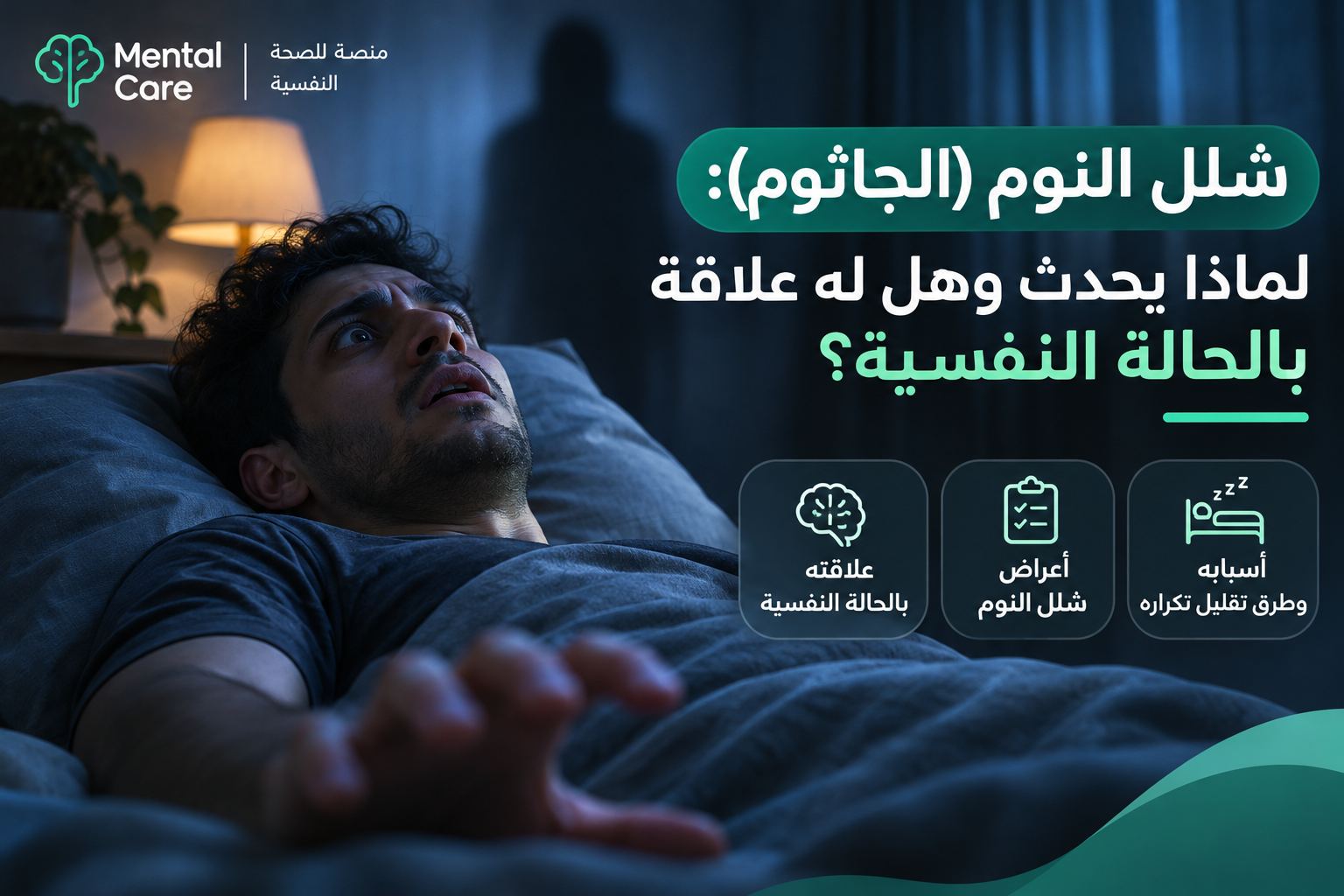


Imagine waking up during the night and recognizing your bedroom but being unable to move your arms, legs or voice.
You may try to sit up but cannot.
You might even feel that someone is standing nearby or that something is pressing on your chest.
Then, seconds or minutes later, movement returns.
This experience is known as sleep paralysis.
In this Mental Care guide, we explain why sleep paralysis happens, why people sometimes see or sense a presence during an episode, how it may relate to stress and anxiety, and when recurrent episodes need medical assessment.
What is sleep paralysis?
Sleep paralysis is a temporary inability to move or speak during the transition between sleep and wakefulness.
It may occur:
- As you are waking up.
- As you are falling asleep.
During an episode, you may be aware of your surroundings while your body remains temporarily unable to move.
Episodes usually last seconds to a few minutes and resolve on their own.
Why does sleep paralysis happen?
One explanation involves rapid eye movement or REM sleep.
During REM sleep, the brain is highly active and vivid dreaming commonly occurs.
At the same time, most skeletal muscles become temporarily relaxed or inactive.
This normal process helps prevent the body from physically acting out dreams.
During sleep paralysis, awareness appears to return before this REM-related muscle inactivity has completely ended.
In simple terms: the mind wakes up before the body has fully left REM sleep.
What are the symptoms of sleep paralysis?
Symptoms vary, but may include:
- Temporary inability to move.
- Temporary inability to speak.
- Fear or panic.
- A sensation that someone is in the room.
- Visual hallucinations.
- Hearing sounds or voices.
- A sensation of chest pressure.
- A feeling of floating or moving.
Although chest pressure can feel frightening, people remain able to breathe during a typical sleep paralysis episode.
Sleep paralysis can feel terrifying, but the episode is usually temporary
If episodes are becoming frequent or fear of them is affecting your sleep, speaking with a professional may help you understand the wider picture.
Browse SpecialistsWhy do I see someone during sleep paralysis?
This is one of the most frightening parts of the experience.
During sleep paralysis, you may be aware of the room while part of the brain is still close to a dream state.
This overlap between sleep and wakefulness can create vivid sensory experiences.
People may feel:
- That someone is standing beside the bed.
- That a shadow or figure is in the room.
- That something is approaching them.
- That something is pressing on the body.
- That they hear footsteps, voices or other sounds.
Hallucinations that occur while falling asleep are often called hypnagogic hallucinations, while those occurring during waking are called hypnopompic hallucinations.
Do hallucinations during sleep paralysis mean mental illness?
Not necessarily.
Dream-like visual, auditory or physical sensations can occur during the transition between sleep and wakefulness and do not, by themselves, establish psychosis or another serious psychiatric disorder.
However, hallucinations that occur while you are fully awake during the day should be medically assessed, particularly if they are new, worsening or associated with confusion or other symptoms.
Is sleep paralysis dangerous?
Sleep paralysis itself is usually not physically dangerous.
The emotional effect can still be significant.
Some people begin to:
- Fear going to sleep.
- Delay bedtime.
- Sleep fewer hours.
- Become increasingly anxious before bedtime.
This may create an unhelpful cycle in which fear disrupts sleep and disrupted sleep makes future episodes more likely for some people.
What causes recurrent sleep paralysis?
There is no single cause in every case.
Sleep paralysis has been associated with:
- Sleep deprivation.
- Irregular sleep schedules.
- Shift work.
- Jet lag.
- Insomnia.
- Narcolepsy.
- Obstructive sleep apnea in some cases.
- Stress and anxiety.
- Post-traumatic stress disorder.
- Panic disorder.
- A family history of sleep paralysis.
Is sleep paralysis linked to anxiety?
Sleep paralysis has been associated with anxiety and several mental health conditions in some people, but this does not mean anxiety is the cause of every episode.
Stress may disrupt sleep quality and timing, while fear of another episode may increase anxiety around bedtime.
Sleep paralysis can also occur in people who do not have a diagnosed mental health condition.
Can lack of sleep trigger sleep paralysis?
Insufficient and irregular sleep are commonly associated with sleep paralysis.
Late nights, changing sleep times and chronic sleep deprivation can interfere with stable sleep patterns.
Improving sleep regularity is therefore one of the most practical first steps for people experiencing recurrent episodes.
Does sleeping on your back make sleep paralysis more likely?
Sleep paralysis appears to occur more often in some people when they sleep on their back.
If your episodes repeatedly occur in this position, changing sleep position may be worth trying.
Are you becoming afraid to fall asleep?
When fear of another episode begins causing insomnia or persistent anxiety, improving sleep and addressing that anxiety may become an important part of recovery.
Do I Need Therapy?What should I do during sleep paralysis?
An episode normally ends on its own, and there is no guaranteed way to stop it immediately.
Understanding what is happening may help reduce panic.
Try to remind yourself that:
- The episode is temporary.
- Your ability to move will return.
- The frightening sensations may be part of the sleep-wake transition.
Some people find that focusing on a small movement, such as trying to move one finger, helps them feel movement gradually returning.
Can you wake someone during sleep paralysis?
Yes.
Talking to or gently touching someone may help them become fully awake, at which point normal movement returns.
How can I reduce sleep paralysis?
No strategy prevents every episode, but better sleep habits may reduce recurrence.
Keep a regular sleep schedule
Try to go to bed and wake up at approximately the same times each day.
Get enough sleep
Most adults generally need around seven to nine hours of sleep, although individual needs vary.
Reduce late stimulants
Large amounts of caffeine late in the day may make sleep more difficult for some people.
Create a comfortable sleep environment
A dark, quiet and comfortable room may support more consistent sleep.
Reduce emotionally activating content before bed
If news, social media or frightening content makes you more alert or anxious at night, reducing it before bedtime may help.
Address ongoing stress
When chronic stress is disturbing sleep, working on the source of that stress may also support better sleep.
What is the difference between sleep paralysis and a nightmare?
A nightmare occurs during a distressing dream.
After waking, the person can normally move.
With sleep paralysis, the person may feel awake and aware of the bedroom but temporarily unable to move.
What is the difference between sleep paralysis and night terrors?
Night terrors are different.
During a night terror, a person may scream, move or appear extremely frightened while still largely asleep and may remember little the next morning.
During sleep paralysis, the person is generally aware of what is happening but temporarily unable to move.
Does sleep paralysis mean I have narcolepsy?
Sleep paralysis can occur as part of narcolepsy, but it is also common outside the condition.
Sleep paralysis alone does not mean you have narcolepsy.
Medical assessment becomes more important if recurrent episodes occur alongside:
- Severe daytime sleepiness.
- Sudden sleep attacks.
- Sudden muscle weakness triggered by emotion.
- Significant ongoing sleep disruption.
When should I see a doctor about sleep paralysis?
An occasional episode that does not significantly affect your life may not require specific treatment.
Speak with a healthcare professional if:
- Episodes happen frequently.
- You become very anxious or afraid to sleep.
- You are constantly tired or sleepy during the day.
- You have symptoms suggesting another sleep disorder.
- The problem is affecting work, education or daily functioning.
A clinician may ask about your sleep schedule, symptoms, medication, medical history and mental health, and may recommend sleep testing if another sleep disorder is suspected.
Can therapy help with sleep paralysis?
Therapy is not necessary for every case of sleep paralysis.
However, psychological support may be useful when episodes occur alongside:
- Severe anxiety about sleep.
- Persistent stress.
- PTSD, panic disorder or another condition requiring treatment.
- Insomnia caused by fear of future episodes.
The purpose is to address the accompanying psychological difficulty rather than assuming that sleep paralysis itself is a psychiatric disorder.
If you are unsure which professional to choose, read: Therapist vs Psychiatrist: What's the Difference?
A frightening sleep experience does not automatically mean something dangerous is happening
If sleep paralysis is recurring or accompanied by significant anxiety or disrupted sleep, professional assessment can help identify the most appropriate next step.
Browse SpecialistsFrequently asked questions about sleep paralysis
Is sleep paralysis dangerous?
Sleep paralysis itself is usually harmless, although it can be frightening. Recurrent episodes or severe daytime sleepiness should be assessed.
Why do I see someone during sleep paralysis?
Awareness may overlap with dream-related activity during the transition from REM sleep to wakefulness, creating vivid sensations, images or sounds.
Does sleep paralysis mean I have a mental illness?
No. Sleep paralysis can happen without a psychiatric condition, although it has been associated with anxiety, PTSD, panic disorder and sleep disorders in some people.
Can sleep deprivation cause sleep paralysis?
Insufficient sleep and irregular sleep schedules are among the factors commonly associated with sleep paralysis.
How long does sleep paralysis last?
Episodes usually last seconds to a few minutes, although the exact duration varies.
How can I prevent sleep paralysis?
Regular sleep times, adequate sleep, reducing sleep deprivation and addressing stress may reduce episodes, although no method guarantees complete prevention.
When should I see a doctor?
Seek medical advice if episodes become frequent, cause significant fear of sleep, or occur with severe daytime sleepiness or other signs of a sleep disorder.
Read more on Mental Care
- How Do You Know If You Need Therapy?
- Psychological and Physical Symptoms of Anxiety
- How to Choose the Right Therapist
- Therapist vs Psychiatrist
- Browse Mental Care Specialists
Content last updated: November 8, 2026
Medical notice: This article is educational and is not intended to diagnose sleep disorders or mental health conditions. Seek medical assessment if episodes are frequent, you experience severe daytime sleepiness, or unusual symptoms occur while you are fully awake.


